“Never test the depth of river with both the feet.” ― Warren Buffett


Hello, my name is Taisei Koshida, and I am a certified public accountant and tax accountant in Japan.
I assist foreign business owners who may have difficulty dealing with Japanese accounting and tax procedures.
When you start a business in Japan, you may be exempt from consumption tax during the early years. However, you may still choose to become a taxable business or register as a qualified invoice issuer.
Should you do so?
The answer depends on your sales, customers, expenses, and initial investment. Let’s look at the main points.
1. What Is Consumption Tax in Japan?
Japan’s consumption tax is similar to the value-added tax (VAT) used in many other countries.
A taxable business generally collects consumption tax on taxable sales and deducts eligible consumption tax paid on purchases and expenses when calculating the amount of tax payable.
For more information about the basic rules of Japanese consumption tax, please see the article below:
An Easy Explanation of Consumption Tax for Doing Business in Japan
2. When Does a Business Become Subject to Consumption Tax?
In general, a business may be exempt from consumption tax if its taxable sales during the base period are JPY 10 million or less.
The base period is generally two years before the current year for a sole proprietor and two fiscal years before the current fiscal year for a company.
However, there are several exceptions. For example, the taxable sales or certain salary payments during a specified period may affect whether the business is exempt.
In addition, once a business registers as a qualified invoice issuer, it generally becomes a taxable business even if its taxable sales are JPY 10 million or less.
Therefore, a new business should not decide whether it is exempt based only on its current-year sales.
3. Can a New Business Receive a Consumption Tax Refund?
A new business may have large expenses or investments before it generates significant sales.
In such a case, eligible consumption tax paid on purchases may exceed the consumption tax collected on sales.
If the business is a taxable business and meets the applicable requirements, it may be able to receive a consumption tax refund.
However, an exempt business generally cannot receive a refund of consumption tax simply because it paid a large amount of consumption tax on its expenses.
Therefore, if you are planning a large initial investment, such as purchasing or renovating business property, it is important to consider the consumption tax treatment before making the investment.
4. How Does the Invoice System Affect the Decision?
Japan’s Invoice System started in October 2023.
In principle, a taxable business needs to keep qualified invoices and meet the applicable requirements in order to claim an input consumption tax credit on purchases from other businesses.
This means that some business customers may prefer to deal with suppliers that are registered as qualified invoice issuers.
Therefore, even if your business would otherwise be exempt from consumption tax, registering as a qualified invoice issuer may be worth considering if most of your customers are businesses.
On the other hand, if most of your customers are individual consumers, the business reason for registering may be different.
The decision should therefore depend on your customers as well as the tax cost.
For more information about the Invoice System, please see the article below:
An Easy Explanation of Japan’s Invoice System
5. Comparing Different Business Situations
(1) Businesses With Large Initial Costs or Investments
If your business requires substantial initial spending, becoming a taxable business may sometimes be advantageous because you may be able to claim a refund of eligible consumption tax paid on those costs.
However, you should not look only at the first-year refund. Becoming a taxable business may also affect your consumption tax obligations in later years.
Therefore, it is important to compare the total tax impact over several years rather than focusing only on the first year.
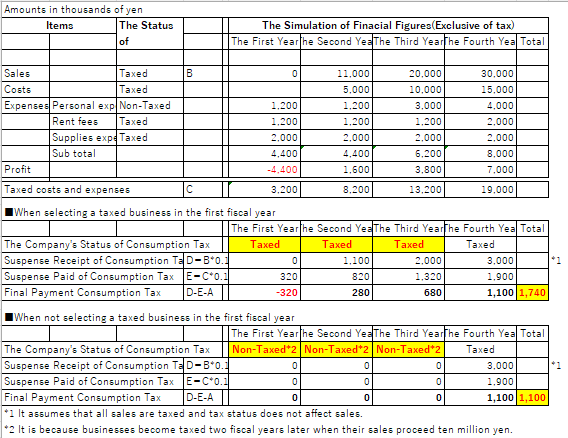

If your business initially needs a lot of money for an investment, selecting a taxed business may sometimes be advantageous.
More detailed information about this is in the following blog.
Consumption Tax on Real Estate Purchases by Private Lodging Businesses 民泊事業者が不動産物件を取得した際の消費税
(2) Businesses With Few Initial Costs or Investments
If your business has relatively few expenses or investments, voluntarily becoming a taxable business may result in an additional consumption tax burden.
However, special or simplified calculation methods may reduce the administrative and tax burden if the applicable requirements are met.
Therefore, the best choice depends on your expected sales, expenses, customers, and future business plans.
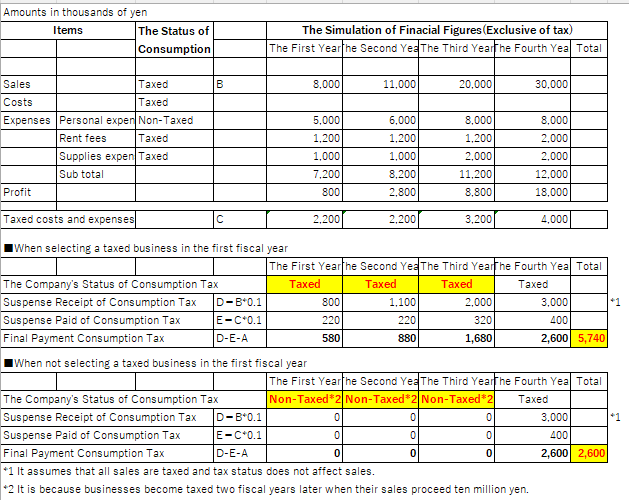

As shown in the simulation above, becoming a taxable business may increase your consumption tax burden.
However, certain temporary or simplified calculation methods may reduce the burden if the applicable requirements are met. One example is the temporary 20% special rule explained below.
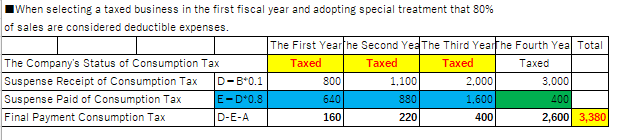

6. A Temporary Special Rule for Small Businesses
A temporary 20% special rule has been available for certain businesses that became taxable businesses as a result of registering as qualified invoice issuers.
Under this rule, the consumption tax payable can generally be calculated as 20% of the consumption tax on taxable sales, if the applicable requirements are met.
However, this is a temporary measure. The 20% special rule applies to eligible taxable periods that include dates from October 1, 2023 through September 30, 2026.
Therefore, businesses should not assume that this treatment will continue indefinitely.
7. Should You Register?
There is no single answer for every new business.
If you expect large initial investments or mainly deal with business customers, registering for consumption tax and as a qualified invoice issuer may be worth considering.
On the other hand, if your initial costs are small and most of your customers are individual consumers, remaining tax-exempt may be advantageous when legally available.
The important point is to compare the tax impact over several years before making the decision.
Koshida Accounting and Tax Office assists foreign business owners in Japan with accounting and tax matters.
If you are starting a business in Japan and are unsure whether to become a taxable business or register as a qualified invoice issuer, please feel free to contact us through the inquiry form.